

Corporate fitness room equipment includes all strength, cardio, and recovery equipment a company needs to provide employees with a functional training room directly on-site. Unlike in private or studio settings, the main considerations here are multiple use by different people, limited floor space, and a budget that must be approved by HR or management.
- Corporate fitness room equipment in 2026 needs commercial durability, not home gym quality.
- An all-in-one trainer like the Force USA G3 covers multiple exercises in a small footprint.
- Floor space, structural integrity, and floor loading must be clarified before ordering, not after.
- Recovery and mobility areas are often forgotten during initial planning.
- Delivery and on-site assembly are part of the corporate fitness room equipment, not an additional item.
Why the right corporate fitness room equipment matters for businesses
A corporate fitness room is rarely used by one person, but rather by ten, twenty, or fifty different employees—often multiple times a day, with varying levels of training experience and without supervision from a trainer. This fundamentally changes the requirements for the equipment: durability, ease of maintenance, and warranty terms matter more than aesthetics.
Equipment from the home gym segment is designed for use by one or two people. In a corporate fitness room, this same level of use is repeated throughout the day—closer to studio use than living room use. If you cut corners in the wrong place with corporate fitness room equipment in 2026, you will often end up paying to replace it within two to three years.
The same applies to complementary areas such as mobility or Pilates: the Hegren TALMA 62 is designed by the manufacturer for users weighing up to 150 kg—a benchmark for continuous commercial use that corporate fitness room strength equipment should also be based on.
In practice, planning a corporate fitness room almost always follows the same sequence, even though companies often skip steps.
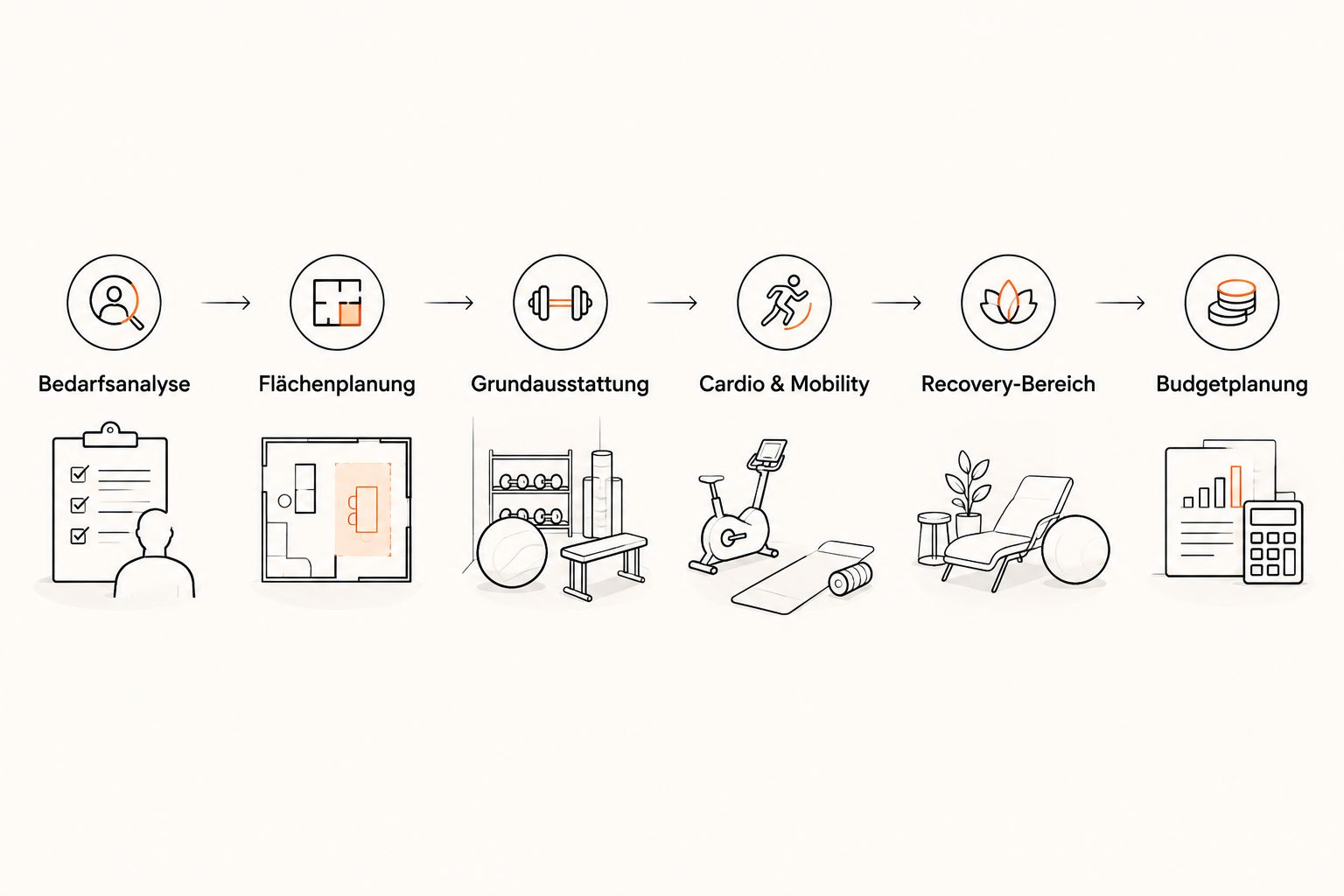
Step 1: Analyze your employees' needs
Before a single piece of equipment is ordered, it must be clear who uses the room, when, and for what. A brief internal survey is usually sufficient and provides the data needed to justify every purchasing decision later.
- Conduct a brief survey of all employees about their fitness goals (strength, endurance, relief from sitting)
- Determine the number of simultaneous users during peak times such as lunch breaks or after work
- Roughly assess training experience: beginners, advanced users, or a mix
- Inquire about special needs, such as back pain or posture problems caused by working from home
- Document preferred training times to establish the room's opening hours
Step 2: Calculate floor space, flooring, and structural integrity
The second hurdle is structural, not athletic. Corporate fitness rooms are often created in basements, side rooms, or repurposed meeting rooms—spaces that were not originally designed for strength equipment with free weights or cable systems. The floor space required per piece of equipment should always include the range of motion, not just the equipment's footprint.
Structural integrity and floor loading must be clarified with the building management or a structural engineer, especially in older buildings and above office spaces with sensitive ceiling constructions. Ceiling height for pull-up bars or cable crossover systems and sufficient power outlets for cardio equipment are two points that are most frequently overlooked in practice.
Step 3: Choose the basic equipment for strength and functional training
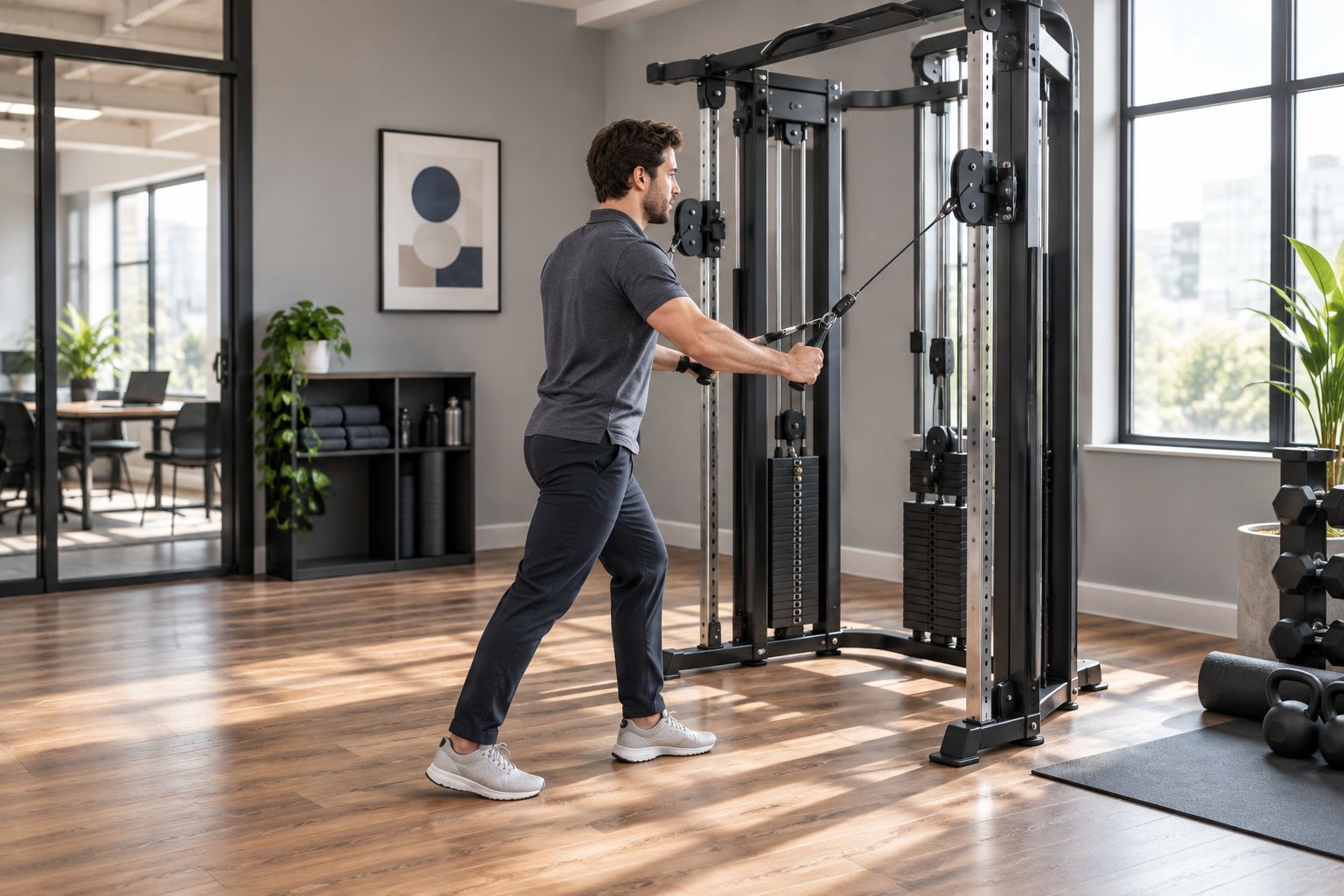
This is where things get concrete. With limited space and different users, a multi-station machine almost always beats a combination of several individual pieces of equipment—it covers cable exercises, squats, and bench presses in a single footprint.
An all-in-one trainer like the Force USA G3 is suitable for corporate fitness rooms with five to twenty active users because multiple exercises can be performed one after another without reconfiguration. If you have more space and prefer a classic layout, instead combine a Smith machine with cable system with a freestanding, adjustable dumbbell bench. Safety locks and safety hooks should be checked on every rack system before first use, and instructing the staff should be a standard part of the handover, not left to chance.
Step 4: Add cardio and mobility equipment
Strength training alone rarely meets all the needs of a diverse workforce. Cardio equipment and mobility areas increase the actual use of the room because they also appeal to employees who do not want traditional strength training.
At least one quiet cardio machine for office environments, mats and small equipment for stretching, and a dedicated, separate area for warming up and cooling down cover most cases. If there is noticeable interest from the staff, a dedicated mobility or Pilates corner is worth planning as a separate item rather than squeezing it into a corner later.
Step 5: Plan a recovery area
Recovery is almost always forgotten during initial planning and then added as an afterthought in the hallway. If you include it from the start, you will save yourself a second renovation phase.
Compression or massage equipment for after training, sufficient power outlets near the training area, and clear time slots for training and recovery in small rooms are the three points that make the difference. Hygiene items such as disinfectants and towels should be firmly included in the budget, not treated as an afterthought.
Step 6: Clarify safety, maintenance, and responsibility
A corporate fitness room without a clear point of contact will lose quality within a few months—loose screws, damaged upholstery, and missing spare parts will go unnoticed.
- Designate an internal or external point of contact for maintenance and malfunctions
- Schedule maintenance intervals according to the manufacturer's specifications in the calendar
- Post usage rules with safety instructions clearly in view
- Clarify insurance and liability issues with the legal department or insurer
- Establish a simple internal reporting channel for defective equipment
Step 7: Plan the budget and procurement
The purchase of a corporate fitness room usually goes through a capital expenditure request, not the operating budget. Those who know the process will get approval faster.
Purchase costs and ongoing costs such as maintenance and wear parts should be listed separately. Delivery times should be coordinated early with the planned opening or move-in date, and delivery including on-site assembly should be a standard part of the quote, not an additional item that only appears later.
Comparison: Options for corporate fitness room equipment in 2026
| Option | Best for | Limitation |
|---|---|---|
| All-in-one functional trainer | Companies with limited space and many different users | Higher investment than a single piece of equipment |
| Smith machine with cable system + bench | Companies with a dedicated strength room and experienced users | Requires more floor space and instruction |
| Mobility and Pilates corner | Offices focused on posture and relief from sitting | Does not cover traditional strength training |
| Recovery area with compression | Companies focused on recovery after exertion | Does not replace active training |
Typical mistakes with corporate fitness room equipment
The same mistakes keep occurring with corporate fitness rooms, regardless of industry or company size.
- Checking floor loading and structural integrity only after ordering, not before
- Buying home gym equipment instead of commercial equipment because it seems cheaper
- Not designating a fixed point of contact for maintenance and malfunctions
- Planning only strength training and completely omitting cardio or recovery areas
- Clarifying delivery time and assembly only shortly before the planned opening date
Have your corporate fitness room configured
Request a quote with delivery and on-site assembly.
You can find equipment for companies, hotels, and studios with commercial use in the Studio & Commercial category.
FAQ
What is included in the basic equipment of a corporate fitness room?
The basic equipment usually consists of a multi-station or strength machine, an adjustable dumbbell bench, and at least one cardio machine. Mobility and recovery areas are added depending on the goals of the staff.
How much space does a corporate fitness room need?
The required space depends on the number of pieces of equipment and the range of motion of each user, not just the footprint of the equipment. The best way to calculate this accurately is based on the planned equipment list.
Are home gym machines suitable for a corporate fitness room?
Home gym machines are generally designed for one or two people and will not withstand repeated use by an entire staff over time. Equipment with commercial durability and an appropriate warranty is better suited for corporate fitness rooms.
Who handles the delivery and assembly of the equipment at the company?
At Kraftathlet, delivery, on-site assembly, and instruction are part of the corporate fitness room equipment, not a separate additional service. The process is coordinated in advance with the company's opening date.
How much does it cost to equip a corporate fitness room?
The costs depend on the space, number of users, and level of equipment, and cannot be reliably estimated with a flat rate. A quote based on the planned equipment list provides reliable figures for 2026.
Does a corporate fitness room need its own cable crossover station?
A cable crossover station covers many exercises in a small footprint and is particularly worthwhile when space is limited and users are different. It replaces several individual pieces of equipment without requiring additional floor space.
How often does equipment in a corporate fitness room need to be maintained?
Maintenance intervals are based on the manufacturer's specifications and the actual intensity of use of the room. With daily multiple use by different employees, shorter inspection intervals make sense than in a private setting.
Is a recovery area in a corporate fitness room worthwhile?
A recovery area increases the actual use of the room because it also appeals to employees who are not looking for traditional strength training. It does not replace active training, but complements it effectively.
One last thing
Most inquiries about equipping a corporate fitness room revolve around price and floor space – the warranty terms are rarely questioned. Yet this is exactly where it pays to look closer: With the Hegren TALMA 62, the periods vary depending on the component: Hegren offers a 10-year manufacturer's warranty on all metal parts, 2 years on rollers and wooden surfaces, and 1 year on handles, cables, springs, and synthetic leather. Your statutory warranty rights remain unaffected. Anyone investing in continuous commercial use in 2026 should check this distinction individually for every piece of equipment in the corporate fitness room, not just the reformer.