

Power racks for functional fitness boxes are sturdy strength training stations for squats, bench presses, pull-ups, and cable exercises, designed to accommodate multiple athletes per class hour in limited space. Unlike in a home gym, the appearance of a single station is less important than how quickly a group can rotate between exercises without forming a queue in front of the rack.
- Power racks for functional fitness boxes need to accommodate more users per hour than home gym racks, not more space per user.
- An all-in-one trainer like the Force USA G3 combines a rack and cable machine in a single station, saving valuable square footage in 2026.
- 7.6 x 7.6 cm frame profiles made of at least 11-gauge steel are considered the minimum standard for daily class use.
- Freestanding rack or rig system: The decision depends on the class rotation format, not on the budget alone.
- Kraftathlet delivers and installs power racks on-site in Germany and Austria with a dedicated point of contact.
Why Power Racks Are Important for Functional Fitness Boxes
A functional fitness box thrives on classes, not individual training. Ten to twenty athletes must rotate through the same exercises within an hour, and every blocked station costs the entire group time. This makes planning fundamentally different from a traditional weight room, where a rack may be used by one person for hours.
This creates three requirements that should take precedence over appearance when making a selection:
- Throughput – how quickly can the station be switched between athletes
- Durability – how many usage cycles per day can the frame withstand without wearing out
- Modularity – can the station be expanded later with a cable machine or additional grips as class sizes grow
A Force USA G3 All-in-One Trainer covers a rack, cable machine, and guided exercises in a single station – for boxes with limited space, this is often a more practical solution than three separate machines side by side. Our assessment: For functional fitness boxes with limited space, a combined all-in-one trainer is a more efficient choice than separate individual machines.
Planning Power Racks for Functional Fitness Boxes: The Steps
1. Determine the Space Required for Each Training Station
First, measure the actual space required for a station, including a safety clearance for barbell movements, not just the footprint of the rack itself. Squats and cleans require space in front and behind, while the bench press needs space on the side for a spotter. If you plan too tightly here, you will have to remodel in 2026 as class sizes grow.
2. Define the Usage Mode: Classes vs. Open Training
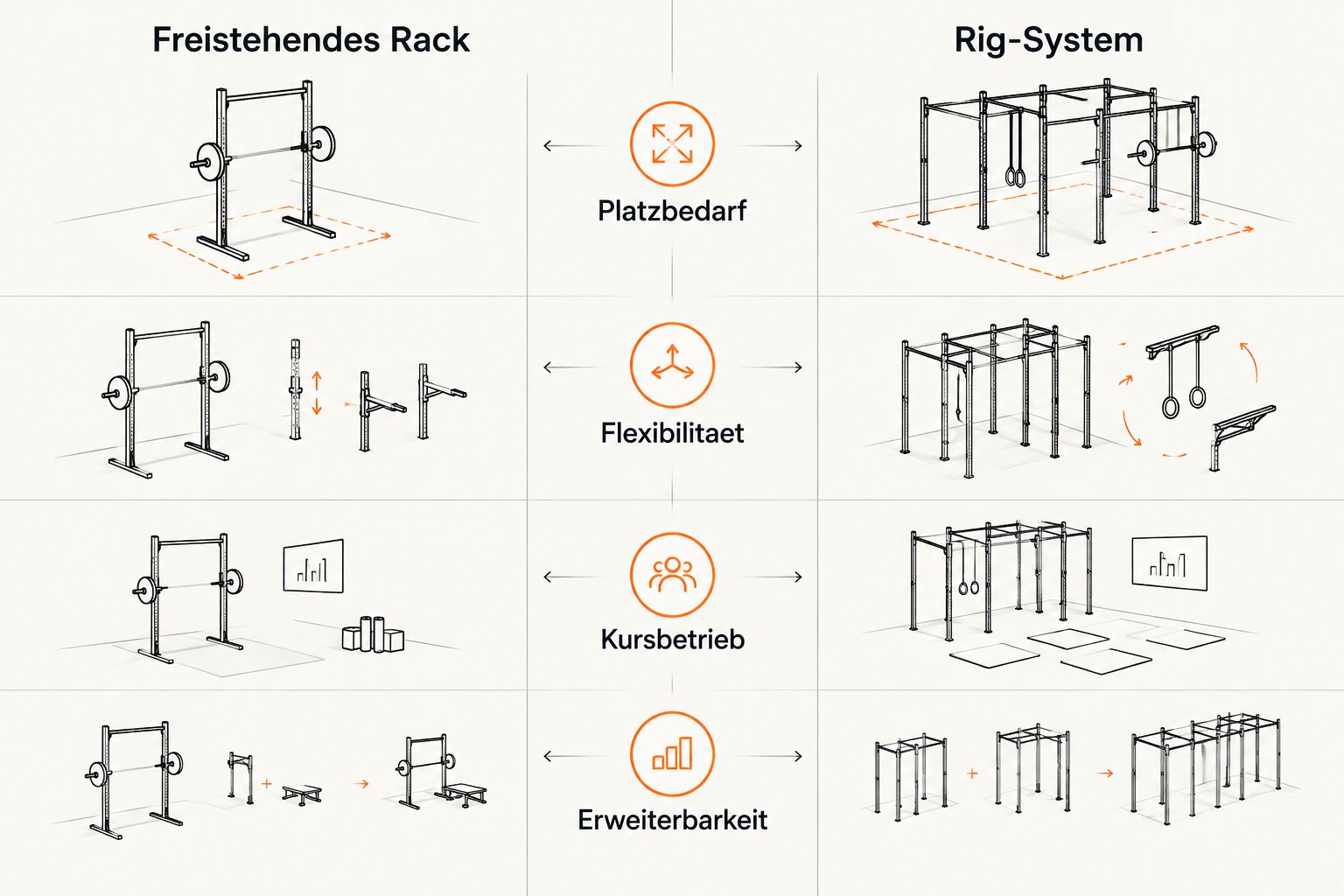
A box with fixed class times needs more parallel stations than a box with open training throughout the day. With fixed class times, the load is concentrated during a few hours, while with open training, it is spread out – this directly affects whether a single freestanding rack is sufficient or whether a rig system with multiple stations makes more sense.
3. Check Frame Quality and Equipment
7.6 x 7.6 cm (3 x 3 inch) frame profiles made of at least 11-gauge steel are considered the industry minimum standard for racks that are used by different users multiple times a day. Rack heights of around 220 cm are common because they accommodate pull-up bars and cable machine attachments without additional add-ons. Cheaper home gym racks are often not designed for this continuous operation.
4. Choose Between a Freestanding Rack and a Rig System
A freestanding power rack can be moved flexibly and is suitable for boxes that still want to change their layout. A permanently installed rig system with multiple stations provides higher throughput during high-frequency class schedules, but it is fixed in place. The decision depends on the class rotation format: if athletes switch stations every few minutes, a rig system with multiple identical stations will pay off.
5. Plan for Cable Machines and Additional Stations
A cable machine significantly expands a rack's exercise options without taking up additional space if it is attached directly to the rack instead of standing as a separate machine. A Smith machine with a double cable machine covers guided movements and free cable exercises in a single machine – relevant for boxes that offer rehab or strength-building work in addition to CrossFit formats.
6. Clarify Safety Clearances, Delivery, and Installation
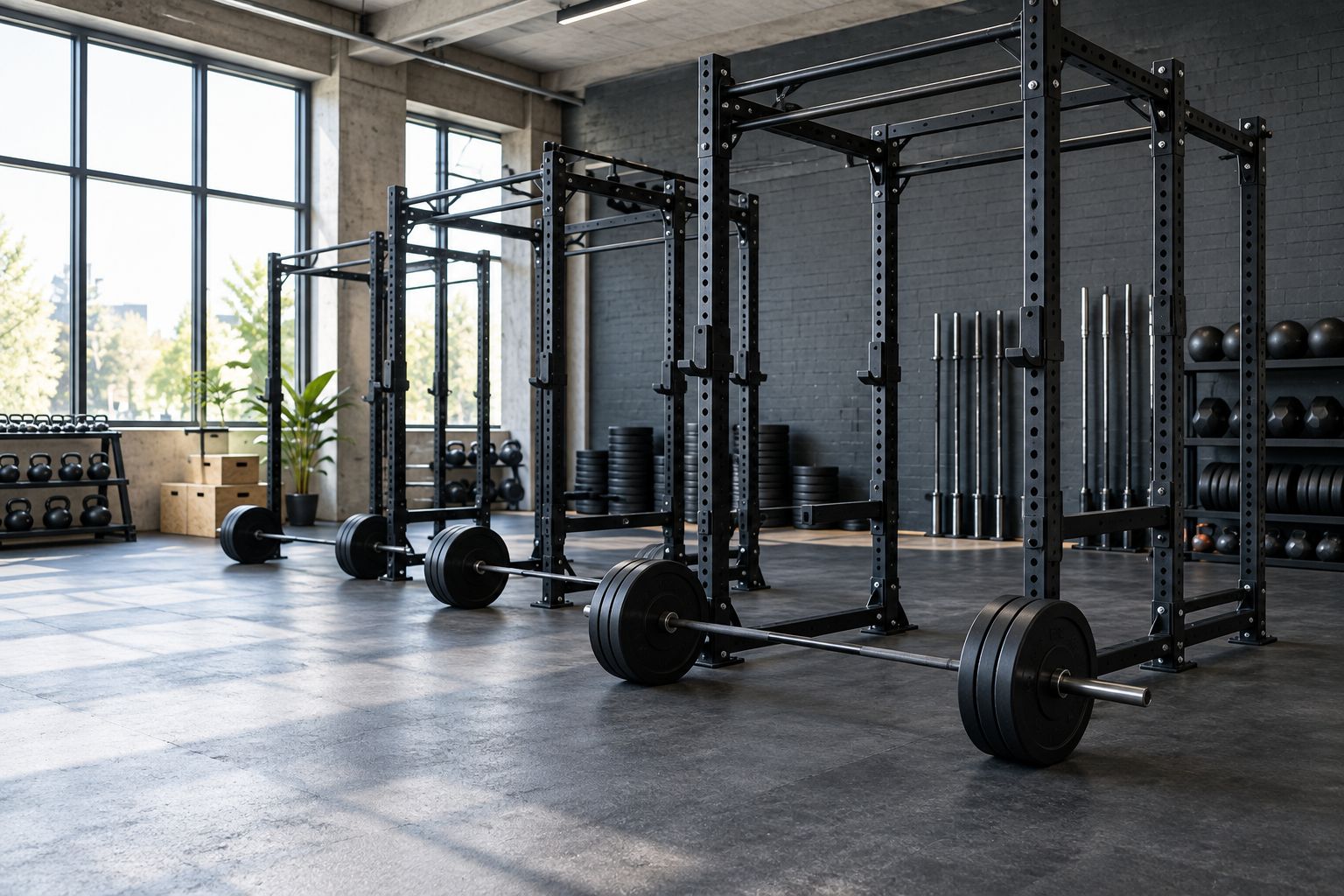
Safety clearances between stations are not a nice-to-have; they prevent collisions during barbell movements in a crowded class room. Before ordering, clarify who delivers, who installs, and who is available to answer questions – especially with multiple stations, this makes the difference between an opening date that holds and one that gets pushed back. Kraftathlet delivers power racks for functional fitness boxes in Germany and Austria, including on-site installation.
Comparison: Power Rack Options for Functional Fitness Boxes
| Option | Best for | Main Limitation |
|---|---|---|
| Compact Half Rack | Small boxes with one to two stations | No integrated cable machine, limited attachments |
| Rig System with Multiple Stations | Boxes with high class frequency and fixed times | Large space requirements, fixed installation with no later reconfiguration |
| All-in-One Trainer with Cable Machine | Boxes that want to combine strength and cable training | Usually only one user per station at a time |
| Freestanding Rack with Accessory Package | Boxes that want to expand an existing rack instead of buying a new one | Retrofitting depends on the compatibility of the base rack |


Common Mistakes When Planning Power Racks for Functional Fitness Boxes
- Planning by space alone, not by throughput – a box with twenty class participants needs more parallel stations than the square footage alone suggests
- Buying home gym racks for class use – frames designed for occasional individual use wear out faster under daily continuous operation
- Treating a cable machine as an afterthought – if you want to add a cable machine later, you should first check whether the selected rack has compatible mounting points
- Underestimating safety clearances – in a crowded class room, clearances that are too tight between stations lead to collisions during barbell exercises
- Only clarifying delivery and installation after ordering – if you are planning a box's opening date, you should fix the delivery time and installation date before ordering, not after
You can find racks, rigs, and wall-mounted racks for boxes in the Power Racks & Strength Rigs category.
FAQ
What is the difference between a power rack and a rig system for functional fitness boxes?
A power rack is a single freestanding station, while a rig system combines multiple stations into a fixed unit. Rig systems are suitable for boxes with high class frequency, while power racks are for boxes that want to keep their layout flexible.
How many power racks does a functional fitness box need?
The number depends on the maximum class size and the rotation format, not on the box's floor space alone. More stations shorten the wait time between sets during full classes.
Is an all-in-one trainer with a cable stack worth it instead of a classic power rack?
Yes, for gyms with limited space, because a rack and cable stack take up less space in a single station. For gyms with plenty of space and high throughput, separate stations are often more practical because multiple athletes can work out at the same time.
How robust should a power rack be for commercial gym use?
For daily commercial gym use with rotating users, 7.6 x 7.6 cm frame profiles made of at least 11-gauge steel are the minimum standard. Home gym racks with thinner profiles are usually not designed for this kind of continuous use.
How much does a power rack for a functional fitness gym cost?
The cost depends on the equipment, cable stack options, and the number of stations. Current configurations and prices can be found directly in the Kraftathlet shop.
Freestanding rack or bolted-down rig – which is better for commercial gym use?
For fixed class times and high throughput, a rig system with multiple stations is more efficient. For open training or a growing layout, a freestanding rack is the more flexible choice.
How long does delivery and assembly of a power rack for a gym take?
Delivery times depend on the manufacturer and the selected configuration. Kraftathlet will clarify the exact dates directly when you make an inquiry, so that they fit your planned opening date.
Can an existing power rack be retrofitted with a cable stack?
This depends on the attachment points of the base rack. Some racks can be retrofitted with a pull-up and cable stack accessory package, while others cannot – this should be checked before purchase.
Finally
Most gyms buy a rack for their current class size in 2026 and face a renovation two years later because membership growth has overwhelmed the stations. Modular systems with retrofittable cable stacks and additional stations – like those Force USA offers for its G-Series – solve exactly this problem without having to completely replace an existing rack. Those who consider this during the initial planning phase will save themselves a second renovation.