

- A strong back is built through two movement patterns: vertical pulling (pull-ups, lat pulldowns) and horizontal pulling (rowing). Both should be included in every workout plan.
- Work your back twice a week with 10 to 20 intense sets—this targets both width (latissimus) and thickness (upper mid-back).
- Technique over weight: Actively engage your shoulder blades, keep your core stable, and generate the pull from your back rather than your arms.
- 61.3% of adults in Germany have experienced back pain in the past 12 months—targeted strength training is one of the most effective ways to prevent it.
Back Training: Exercises, Technique, and a Workout Plan for a Strong Back
To build a strong, broad back, you need two things: vertical pulling exercises like pull-ups and lat pulldowns for width, and horizontal pulling exercises like rowing for thickness. If you train both types twice a week with proper form, you’ll not only build visible muscle but also stabilize your spine and shoulders—an important consideration in a country where, according to the Robert Koch Institute’s BURDEN 2020 study, 61.3% of adults have experienced back pain in the past twelve months.
The back is also the muscle group that plays the biggest role in maintaining good posture in everyday life: it keeps the shoulders back, straightens the upper body, and stabilizes the spine during almost every movement. This guide will show you the most important back muscles, the most effective exercises for each area, the proper technique, and a specific weekly workout plan—for both at home and at the gym.
Which muscles do you work during a back workout?
The back isn't a single muscle group, but rather a network of several muscles with different functions. If you only repeat one exercise, you're leaving potential untapped and risking muscular imbalances. Here are the four areas you should be aware of:
Latissimus dorsi – the width
The latissimus dorsi pulls the upper arms toward the body and creates the characteristic V-shape. It is primarily engaged during vertical pulling exercises such as pull-ups and lat pulldowns, as well as during row exercises. It is the most important muscle for building a broad back—and at the same time, it’s the one that many people train through their arms rather than their back.
Trapezius and Rhomboids—Thickness
The upper middle back, between the shoulder blades, gives the back depth and keeps the shoulders pulled back. It responds best to horizontal rowing and face pulls. A well-developed upper back also visibly improves posture—especially for people who spend a lot of time sitting at a desk.
Back Extensors (Erector spinae) – Stability
The long muscle group running along the spine straightens the upper body and protects the lower spine. Deadlifts, Romanian deadlifts, and hyperextensions are the key exercises here. A strong lower back is the best protection against discomfort in everyday life and when lifting heavy weights.
Back of the shoulder and forearms—the supporting muscles
Almost every pulling exercise also works the rear deltoids and your grip. Both are often the weak points that limit your back training—which is one reason why specifically training your grip and using pulling aids for very heavy sets is a good idea.
Vertical vs. Horizontal Scrolling: Why You Need Both
The most important concept for the back is this: two directions of pull. Vertical pulling (from top to bottom, as in pull-ups or lat pulldowns) emphasizes the width of the latissimus dorsi. Horizontal pulling (toward the body, as in rowing) emphasizes the thickness of the upper mid-back. If you train in only one direction, you’ll develop an unbalanced back—either wide but flat, or thick but without a V-shape.
The simplest rule for a balanced workout plan: Include at least one vertical and one horizontal pulling exercise in every back workout. Supplement these with an exercise for the rear deltoids (face pull) and, if needed, an exercise for the erector spinae. This way, you’ll cover all areas in a short amount of time.
The Best Back Exercises by Area
The following table categorizes the most important exercises by their primary stimulus. A good workout plan combines at least one vertical pull exercise and one horizontal pull exercise.
| Exercise | Pattern | Primary muscle | Level |
|---|---|---|---|
| Pull-up | Pull vertically | Latissimus | Advanced |
| Lat Pulldown | Pull vertically | Latissimus | Beginners |
| Barbell Rows | Drag horizontally | Upper center of the back | Advanced |
| Seated Cable Rowing | Drag horizontally | Rhomboids, Trapezoids | Beginners |
| Deadlift | Hip Extension | Back extensor, entire back | Advanced |
| Face Pull | Drag horizontally | Rear shoulder, trapezius | Beginners |
You can find in-depth technical instructions in our detailed guides on lat pulldowns, barbell rows, and pull-ups.
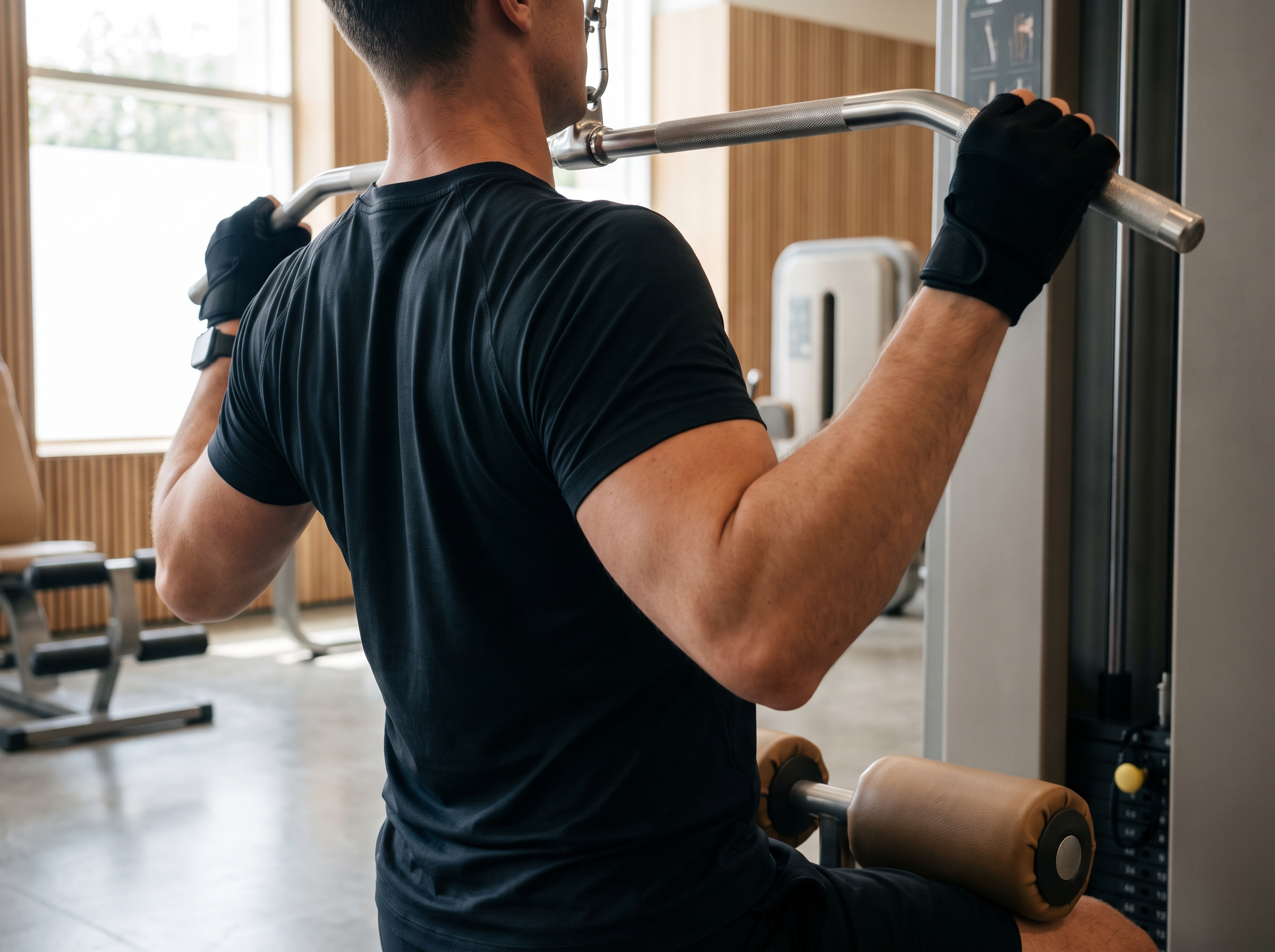
Proper Technique: Pull with Your Back, Not Your Arms
The most common mistake in back training is to drive the movement with your arms. When you do that, your biceps do most of the work, and your back gets hardly any stimulation. The trick is to consciously think of your back as the driving force behind the movement. These basic principles apply to nearly every pulling exercise:
- Start with your shoulder blades. Pull your shoulder blades together and down before bending your elbows. This way, the movement starts in your back instead of your arm.
- Guide your elbows. Remember to pull your elbows back or down—your hands are just hooks.
- Controlled eccentric contraction. Lower the weight over two to three seconds and avoid using momentum. The lowering phase is just as important for muscle growth as the lifting phase.
- Full range of motion. Lift until you reach full contraction, and at the end, lower the weight in a controlled manner until you feel the stretch. Half-reps yield half the results.
- Keep your back neutral. When rowing and deadlifting, keep your spine straight; rounding your back under load is the main cause of injuries.
Grip Variations and Their Effects
You control the stimulus by adjusting your grip width and direction. A wide overhand grip emphasizes the outer portion of the latissimus dorsi, while a narrow or underhand grip shifts the focus more toward the lower latissimus dorsi and engages the biceps. A neutral grip (palms facing each other) is often easier on the shoulders. Vary your grip throughout the weeks to target all parts of the back.
Workout Plan: Back, 2 times a week
For muscle building, about 10 to 20 intense sets per muscle group per week has become the standard range. Spread them out over two workouts to maintain high quality per set—two shorter, focused workouts are better than a single, exhausting one. A proven routine for an upper/lower body or push/pull split:
| Unit | Exercise | Sets × Reps |
|---|---|---|
| Pull A | Pull-up or Lat Pull-down | 4 × 6–10 |
| Pull A | Barbell Rows | 3 × 8–12 |
| Pull A | Face Pull | 3 × 12–15 |
| Pull B | Seated Cable Rowing | 4 × 8–12 |
| Pull B | Close-grip lat pull-down | 3 × 10⁻¹² |
| Pull B | Back Extender / RDL | 3 × 8–12 |
Over the course of several weeks, increase your reps or weight (progressive overload), keep 1 to 3 reps in reserve, and schedule a lighter "rest" week every 6 to 8 weeks. Keep track of your sets—you can only improve in a targeted way if you measure your progress.
Back Workouts at Home vs. at the Gym
At home, a pull-up bar, a cable machine, and a barbell form the foundation for a comprehensive back workout. At the gym, additional machines such as the lat pulldown, rowing machine, and T-bar row come into play, allowing you to target specific areas more effectively. For building muscle, both approaches are equally effective as long as you cover both pulling movements and consistently increase the intensity. The quality of each repetition is more important than the number of machines you use.
Buying Guide: Back Support Gear
Back training relies on pulling exercises—and for that, you need the right equipment. For horizontal and vertical pulling exercises, a cable machine or functional trainer is essential: you can perform lat pulldowns, rowing, and face pulls with precision and in a way that’s easy on your joints. If you want to lift heavy weights with a barbell—for deadlifts and rowing, for example—you’re well-advised to invest in a sturdy power rack or a multi-gym. You’ll find an overview of all equipment in our Strength Training category.
As an authorized dealer offering a manufacturer’s warranty and serving over 5,000 satisfied customers, we’ll give you honest advice on the right equipment before you buy—whether it’s for a home gym or a fitness studio. That way, you’ll make the right investment the first time, instead of having to do it twice.
Common Mistakes in Back Training
- Too much momentum. If you yank the weight up, you're working on momentum, not the muscle. A clean, controlled lift beats a heavy, sloppy one.
- Just one exercise. Doing only lat pulldowns makes your back wide but flat. Without rowing, you won't build the thickness.
- The biceps take over. If, after your back workout, you can only feel your arms, you're performing the movement using your elbow flexors instead of your back.
- A rounded back during rowing and deadlifts. That’s the biggest cause of injury. It’s better to use less weight and keep your spine neutral.
- Grip strength is often overlooked. Weak grip limits your ability to lift heavy weights. Focus on training it specifically, or use grip aids during your final sets.
- No progression. If you lift the same weight week after week, you’re not giving your muscles a reason to grow. Increase the weight in a planned manner.
Frequently Asked Questions
How often should I work out my back?
Twice a week is ideal for most people. This way, you spread the volume (10 to 20 sets) across two high-quality workouts while still giving your muscles enough time to recover between workouts.
Which is better: pull-ups or lat pulldowns?
Both exercises target the latissimus dorsi. Pull-ups are more challenging and also engage the core and grip, while lat pulldowns allow for more precise control. Beginners should start with lat pulldowns and work their way up to their first pull-up at the same time.
Does rowing also work out the lower back?
During the bent-over barbell row, the lower back works isometrically as a stabilizer. For targeted stimulation of the back extensors, deadlifts, Romanian deadlifts, or hyperextensions are more effective.
Does back exercise help relieve back pain?
Targeted, technically sound strength training is considered one of the most effective ways to address nonspecific back pain because it stabilizes the core and spine. If you have acute or persistent symptoms, you should consult a doctor first.
Do I need equipment, or is my own body weight enough?
Bodyweight pull-ups and rows will take you a long way. However, for targeted progression and a wider variety of exercises, a cable machine and free weights offer much greater flexibility.
Conclusion
A strong back isn’t a matter of chance—it’s the result of vertical and horizontal pulling, proper form, and consistent progression across two workouts per week. Those who master these fundamentals will not only build a broad, thick back but also prevent the back problems that are so common in Germany. Not sure about what equipment you need? Talk to us —we’ll help you find the right gear for your goals.