

An MMA cage sitting directly on the bare gym floor is both a safety risk and a guarantee issue for the flooring. When properly combined, the mat flooring lies completely under the fighting area and in the perimeter area before the cage is even assembled – then dimensions, transitions, and loads fit together from the start.
- Properly combining an MMA cage and mat flooring in the studio means: lay the mats first, then position the cage.
- The 7 m MMA competition cage with a 9 m podium requires several mat panels measuring 3.6 × 3.6 m, which must be in place before assembly.
- The Flexi-Roll mat flooring with a Velcro system connects panels without a step edge and prevents slipping under the frame.
- The 2 m difference between the 7 m octagon and the 9 m podium is a safety distance, not a cut-off.
- Wrestling mat flooring is the alternative if grappling is also trained on the same surface.
Why the order matters
Most mistakes when setting up a combat sports studio in 2026 do not happen at the cage, but on the floor beneath it. An MMA competition cage with a 7 m octagon diameter and 9 m podium covers an area that no single mat panel covers – the available studio mat panels come in 3.6 × 3.6 m pieces. If you set up the cage first and then puzzle the mats inside, you cut around the base plates and create transitions that lift over time.
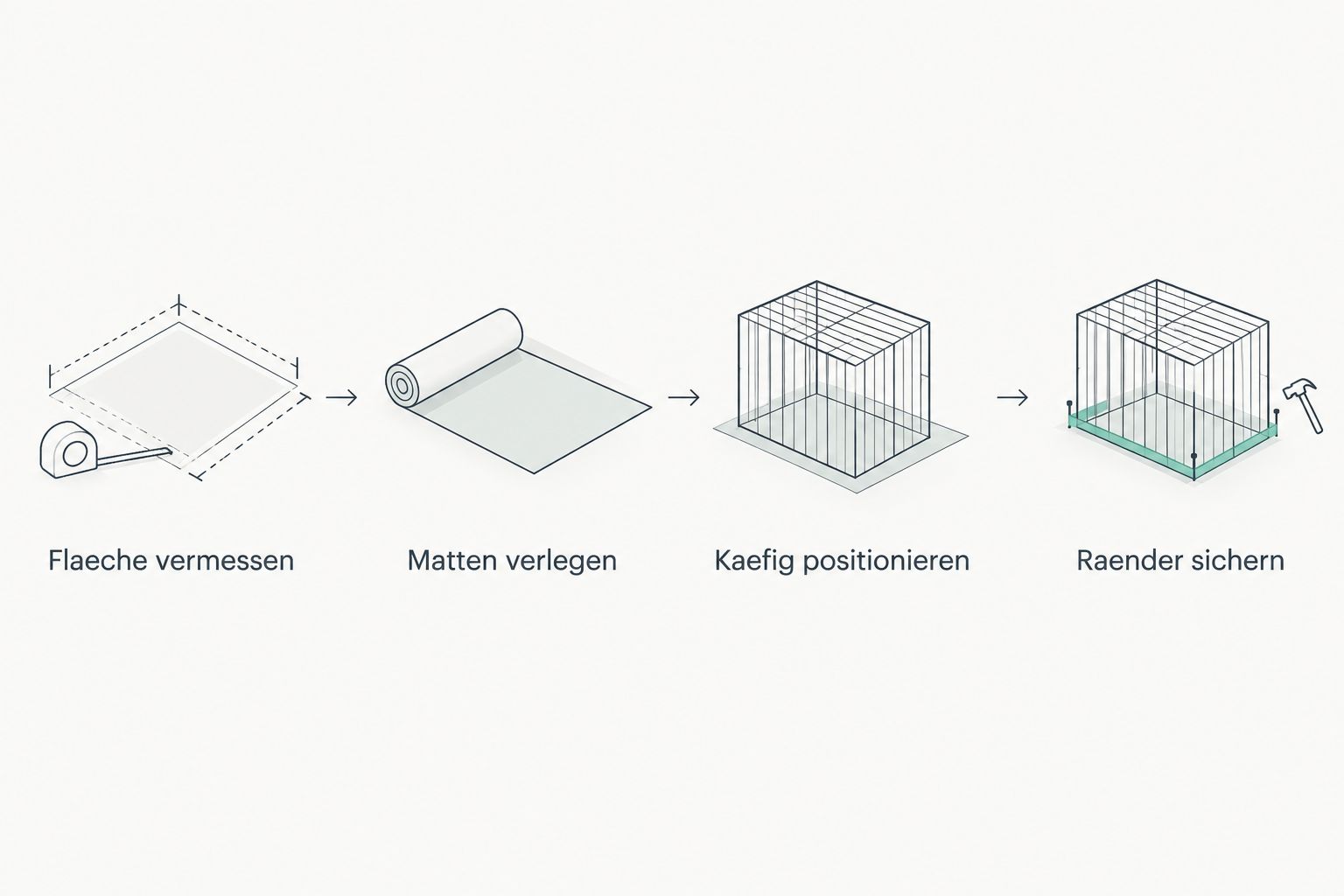
The correct procedure is the opposite: measure the area, lay and connect the mats over a large area, and only then place the cage on the finished surface. This keeps the base plate on continuous material instead of on a seam between two panels.
Before you start
- Check the load-bearing capacity of the gym floor. A 7 m cage with a podium brings considerable weight to a limited area together with the mats and audience load – this should be clarified before ordering, not after.
- Measure the ceiling height and escape routes. Podium height plus cage height noticeably reduces the free height in the room; plan this before purchase.
- The Gotcha: Never lay the mat panels so that a Velcro connection lies exactly under a cage base plate or a post. The seam works under the point load, lifts after a few weeks, and becomes a tripping hazard right at the cage edge. Plan the panel direction so that seams run between the standing points of the frame, not under them.
Prepare the floor area
- Measure the planned area with at least a 1 m buffer beyond the podium diameter – for a 9 m podium, that means a real working area of around 11 m for laying and later maintenance.
- Clean the substrate completely; dust and grit under rubber mats lead to squeaking noises and accelerated wear of the underside.
- Mark the center axis of the octagon with chalk or tape before the first mat panel is laid. This marking is your reference point for all subsequent steps.
Result: a clean, measured area with a marked center – ready for the first mat panel.
Lay and connect the mat flooring
- Lay the first panel of the Flexi-Roll studio mat (3.6 × 3.6 m, 4 cm thick) centered over the marked axis.
- Connect the second panel using the Flexi-Connect Velcro system – the seam must lie flush, without a visible gap or overlap.
- After connecting, check with a spirit level or by walking over it whether the surface is level. Unevenness at the seam only shows under load, not by just looking at it.
- Only cut the mat to size after the cage base plates (see next section) are precisely positioned – never before by estimation.
Result: a continuous, level mat surface of at least 3.6 × 3.6 m per panel pair, connected without a step edge.
Position the cage
- Place the base plates of the MMA competition cage on the finished mat surface, oriented to the previously marked center axis.
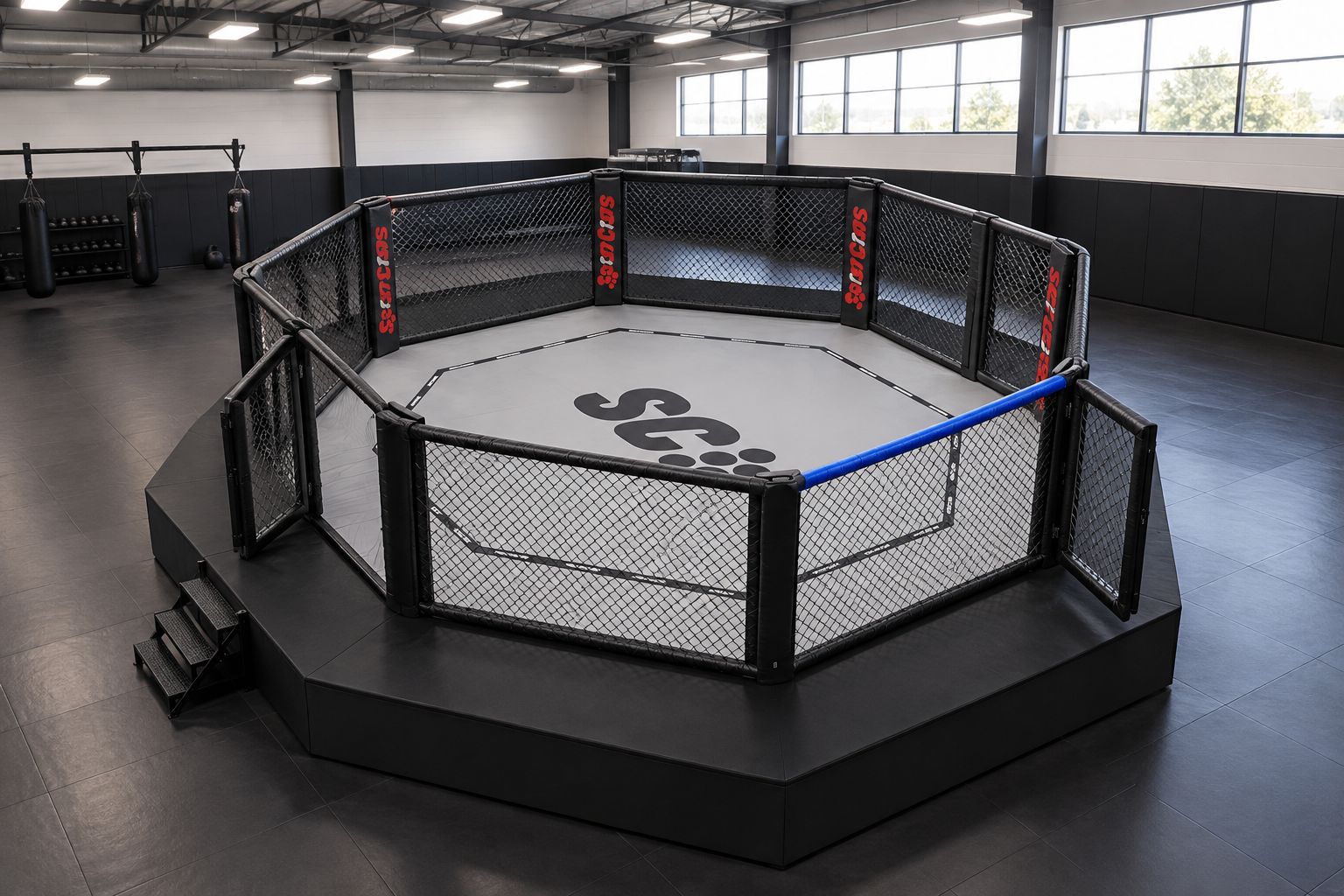
- Assemble the eight panels of the octagon in the order specified by the manufacturer – with a 7 m cage and a 9 m podium, a walkway of about 1 m width runs around, giving cameramen and support staff space without reducing the fighting area.
- After assembly, check that both doors open and close freely and without resistance on the mat.
- Secure the base plates against slipping – on a 4 cm thick mat, this requires different fastening values than on bare concrete; check the manufacturer's specification for your substrate.
Result: a stably standing cage whose doors swing freely and whose base plates do not stand on a mat seam.
Secure transitions and edges
The transition between the podium edge and the gym floor is the point where most studios in 2026 need to make improvements. An unsecured edge at this point is a tripping hazard for anyone walking over the walkway.
Place an additional floor protection mat at the door thresholds and at the outer podium edge, instead of simply letting the Flexi-Roll panel run out there. The 100 × 100 cm high-density floor protection mat is suitable for these transition zones because it can be cut and replaced individually without opening the large mat surface underneath.
Additionally, secure all cable channels for ring lights or camera equipment with tape directly on the mat – never under the mat, as this prevents the later easy replacement of individual panels.
Variant: Wrestling mat flooring for grappling times
If grappling or wrestling is trained in the same room at other times, the Wrestling Studio Mat Dollamur Flexi-Roll in the same 3.6 × 3.6 m is an alternative to the standard Flexi-Roll mat. Both systems use the same Velcro connection principle, but differ in surface structure and grip – wrestling mats are designed for ground fighting and frequent skin contact, the standard studio mat rather for mixed training operation with standing techniques and equipment.
Our assessment: For pure MMA cage use, the standard Flexi-Roll mat is sufficient; for combined grappling and wrestling operation, the Dollamur version is the more precise choice.
Typical problems and solutions
- Seam lifts after a few weeks: The Velcro connection lay under a base plate or in a heavily frequented area. Solution: turn the panel direction so that seams run between the standing points of the cage.
- Cage door rubs on the mat: The mat was not cut exactly to the final cage position, but laid beforehand by estimation. Solution: first position the cage finally, then rework the cut at the door.
- Slipping hazard at the podium edge: The transition to the gym floor has no separate protection mat. Solution: add a separate floor protection mat to all edge zones.
- Base plates sink visibly into the mat: With 4 cm thick mats, continuous point load can lead to permanent indentations. Solution: use load distribution plates under the base plates, as is also common with other strength equipment for combat sports studios with high standing weight.


Expanding the Setup
The cage and mat flooring are the core of the area, but rarely the entire training room. Anyone who also offers strength and conditioning training in the same studio needs adjacent space for Power Racks and a Functional Fitness Box – on their own, separate floor space, not on the competition mat itself. For supplementary strength training, it is also worth taking a look at Neck Training in a Combat Sports Studio, because the neck muscles are heavily used in combat sports.
You can find folding and permanently installed cages in the MMA Cages & Octagons category.
FAQ
What mat size is suitable for a 7 m MMA cage?
For a 7 m octagon with a 9 m podium, you need several strips of the 3.6 × 3.6 m studio mat, which are connected via a Velcro system. A single strip is not enough for the total area.
Must the cage be set up before or after the mat flooring?
The mat flooring is laid out and connected over a large area first, and the cage is then placed on the finished surface. This prevents base plates from sitting on a mat seam.
How thick should the mat flooring be under an MMA cage?
The available Flexi-Roll studio mat is 4 cm thick and is designed for continuous training operation under a competition cage. Thinner floor protection mats are more suitable for transition areas than for the main area.
What is the walkway for the 7 m cage with a 9 m podium?
The walkway is the approximately 1 m wide border area between the 7 m octagon and the 9 m podium. It gives cameramen and support staff space without reducing the actual fighting area.
Is a wrestling mat better than a standard studio mat under the cage?
For pure MMA cage use, the standard Flexi-Roll mat is sufficient. If grappling or wrestling is also trained in the same room, the Dollamur wrestling mat is the more precise choice because of its surface structure.
How do I prevent the mat seam from lifting under the cage?
Plan the strip direction so that the Velcro connection runs between the cage stand points, never directly under a base plate or post. Continuous point load on a seam is the most common cause of later tripping edges.
Do I need an additional mat at the edge of the podium?
Yes, a separate floor protection mat at door thresholds and the outer edge of the podium prevents slipping and can be replaced individually without opening the large mat area underneath.
Finally
The difference between a 7 m octagon diameter and a 9 m podium is not a random measurement, but exactly the safety distance all around – 2 m in total, distributed on both sides, so 1 m walkway each. Anyone who plans this border area when laying the mats instead of improvising it afterwards saves the greatest amount of rework on the entire setup in practice.