

Strength equipment for combat sports studios includes strength and pulling training equipment specifically designed for the movement patterns of boxing, MMA, BJJ, kickboxing, and wrestling – with the goal of building explosive power, grip, and neck stability without blocking the area for sparring and mats. Unlike in a traditional gym, every square meter counts twice here because the ring, cage, or mat area takes up most of the space.
- Strength equipment for combat sports studios in 2026 means space-saving cable crossover and functional trainer solutions rather than traditional machine parks.
- Neck training with devices such as the Iron Neck 3.0 Pro belongs in every studio with clinching or grappling.
- An all-in-one trainer like the G3 from Force USA replaces several individual devices on a single footprint.
- Recovery equipment should be planned from the start, not squeezed into a leftover corner later.
- Free floor space next to the ring or cage takes priority over additional strength stations in 2026.
Why the strength equipment selection for combat sports studios is different
A combat sports studio does not plan like a traditional gym. The ring or cage is fixed, mat area for grappling is added, and what remains must cover strength, conditioning, and recovery training at the same time. This restricts the selection of neck training in the combat sports studio and strength equipment more than in a boutique studio without fixed training areas.
In addition, the strain is different: clinching work, takedowns, and striking combinations strain the neck, grip, and core differently than traditional hypertrophy training. Equipment designed solely for muscle building does not meet this need – this is especially evident in the lack of targeted neck training, which is completely missing in many combat sports studios, even though the strain there is highest.
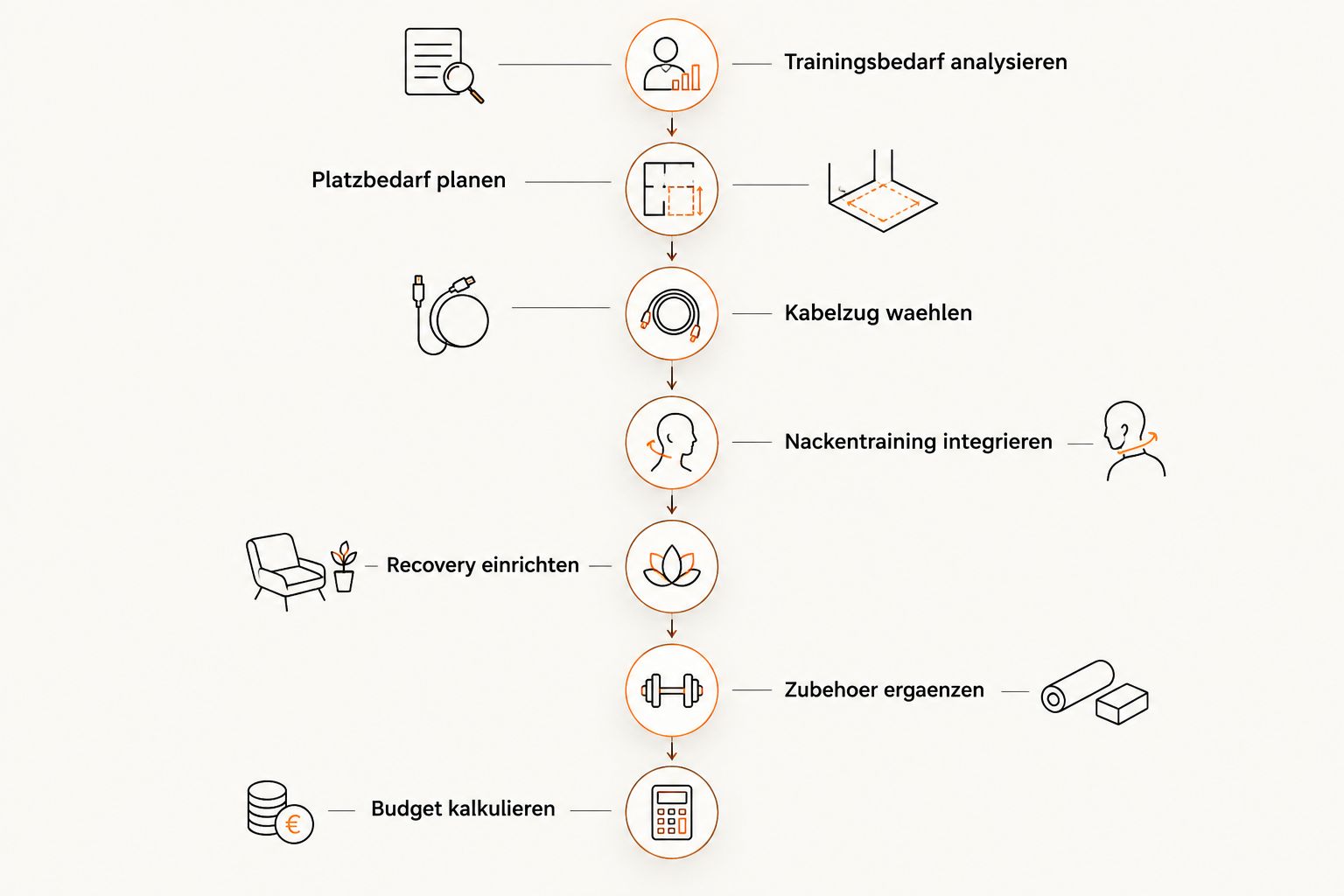
Analyze the training needs of your combat athletes
Before a device is ordered, an inventory is required: Which disciplines do you train, how many athletes at the same time, and which strength deficits are most common in training.
- Boxing and kickboxing: Focus on rotational strength, shoulder stability, grip strength
- BJJ and wrestling: Focus on grip, core strength, neck stability in ground fighting
- MMA gyms: A mix of both plus explosive power for takedowns
- Beginner groups: simple, easily learned basic exercises without complex technical requirements
- Competitive athletes: individual additional devices for specific weaknesses
Plan the space requirements for the strength and conditioning area
A boxing ring measures between 4.90 x 4.90 m and 6.10 x 6.10 m depending on the association's requirements, while an MMA cage is usually around 9 m in diameter. This is the starting point for the area calculation – the strength area is planned around this fixed size, not the other way around.
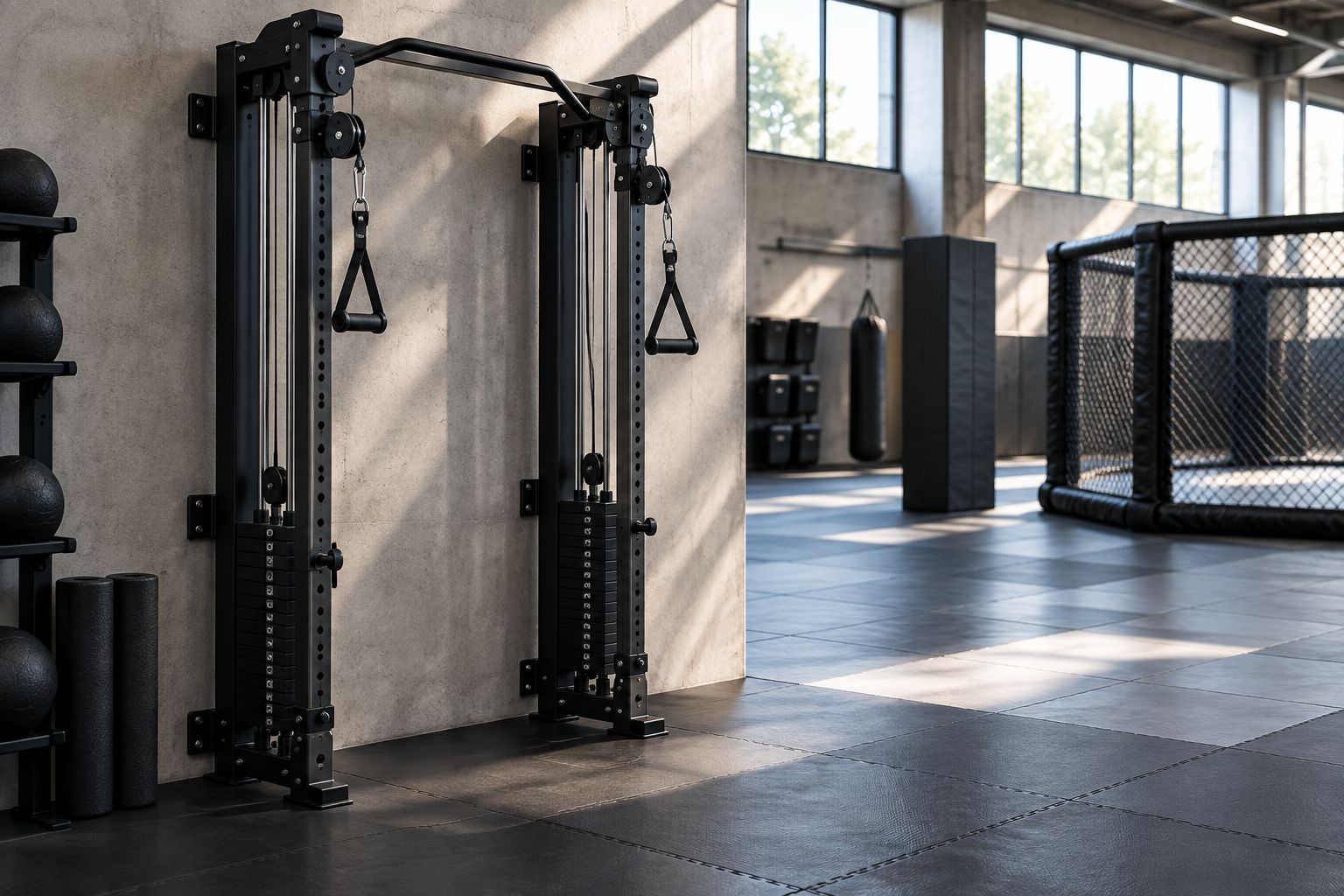
- Wall space for compact cable crossover stations instead of freestanding devices with a large footprint
- Measure the ceiling height for pull-up exercises and overhead work in advance
- Buffer zone between the strength area and sparring area for safety
- Plan storage space for accessories such as jump ropes and bands
- Do not block escape routes and emergency exits with devices
Choose the right cable crossover and functional trainer station
This is where the traditional machine park differs from the combat sports-specific setup. A single station that covers several exercises saves space that you would otherwise need for mats.
- Freestanding cable crossover towers for rotational exercises and pulling movements
- An all-in-one trainer like the G3 All-in-One Trainer from Force USA, which bundles several stations on a single footprint
- Double adjustable cable crossover stations with an integrated rack for combined training
- Adjustable resistance levels for different training levels in a group
- Add-ons such as handles and cable adapters for sport-specific exercises
Integrate targeted neck training
The neck and clinching muscles are more heavily strained in combat sports than in almost any other sport, and yet targeted neck training is completely missing in many studios. A device like the Iron Neck 3.0 Pro specifically trains the neck muscles in multiple directions.
- Rotational training for lateral neck stability
- Flexion and extension exercises for basic neck strength
- Isometric holds for clinching situations
- Individual use, suitable for individual additional training alongside the group
Set up a recovery area
Recovery should be included in the planning from the start, not as an afterthought squeezed into a leftover corner. Compression devices and fascia tools shorten the time between intense training sessions and sparring sessions.
- Compression systems for legs and upper body after intense sessions
- A quiet zone away from the ring and mats for relaxation after training
- Plan for enough power outlets for wireless recovery devices
- Clear separation between the training and recovery area, even in a small room
Supplement with accessories for explosive power and grip
With a limited budget, accessories often make a bigger difference than another large device.
- Jump ropes for the training room for conditioning and footwork
- Pull-up bars for studios for grip strength and back stability
- Adjustable wrist weights for additional resistance during striking training
- Cable adapters for different pulley ratios on existing stations
Calculate the budget and delivery times
Equipment for combat sports studios is usually purchased as a set, not individually over several months. Delivery times for strength equipment and accessories vary depending on the manufacturer and configuration – clarify the opening or expansion date with the supplier early on, rather than checking it at the end of the project.
Comparison: Strength equipment options for combat sports studios
| Option | Best for | Limitation |
|---|---|---|
| Wall-mounted cable crossover station | Studios with limited floor space | Fixed wall position, no relocation |
| All-in-One Functional Trainer (G3/G4) | Studios that want to bundle several stations | Only one person at the device at a time |
| Smith machine with dual pulley and rack | Combined strength and pulling training on a small footprint | Guided path restricts free movement |
| Neck training device (Iron Neck) | Targeted individual training for neck and clinching | No group training possible |
| Free weights and dumbbell sets | Explosive strength exercises, sparring preparation | Requires more supervision and instruction |
Typical mistakes when equipping combat sports studios
- Too little free space next to the ring or cage: Equipment is placed too close to the competition area, which becomes a safety risk during sparring.
- Neck training is skipped: Despite the high strain in clinching, many studios lack any targeted neck equipment.
- Ceiling height not checked: Pull-up bars or cable crossover stations with overhead pulling often do not fit in the room afterward.
- Recovery area as an afterthought: Compression devices end up in a leftover corner instead of being planned from the start.
- Noise sources ignored: Strength equipment directly next to the mat area disrupts technical calls and concentration during sparring.
Plan the strength equipment for your combat sports studio
Tell us the discipline, area, and number of athletes, and we will put together the right configuration.
You can find heavy bag stations, cages, mats, and other combat sports equipment in the Combat Sports category.
FAQ
Which strength equipment do combat sports studios need most urgently in 2026?
In 2026, space-saving cable crossover stations and targeted neck training are top priorities because they provide the greatest training benefit with minimal space requirements. An all-in-one functional trainer complements this if several exercise stations are to be bundled on a single area.
Is a cable crossover station or a functional trainer worth it for a combat sports studio?
A wall-mounted cable crossover station is worth it with very limited space, while a functional trainer like the G3 from Force USA is worth it if several exercises are to be covered by a single device. The decision depends on the available space next to the ring or cage.
How important is neck training for combat athletes?
Neck training is central for clinching, grappling, and striking-heavy disciplines because the neck is constantly under strain during these movements. Devices such as the Iron Neck 3.0 Pro specifically train rotation, flexion, and extension in a single unit.
How much space does a strength area next to the ring or cage need?
This depends on the size of the ring or cage: A boxing ring measures between 4.90 x 4.90 m and 6.10 x 6.10 m depending on the association, while an MMA cage is usually around 9 m in diameter. The remaining space determines whether wall-mounted or freestanding devices make more sense.
Are Smith machines suitable for combat sports studios?
A Smith machine with a dual pulley and integrated rack is suitable if strength and pulling training are to be combined on a small footprint. The guided path restricts free movement patterns, which makes it less suitable than free weights for pure sparring preparation.
What belongs in the recovery area of a combat sports studio?
Compression systems for legs and upper body, as well as a quiet, clearly separated area away from the ring and mats, belong in every recovery area. The planning should be considered from the start, not squeezed into a leftover corner later.
How does the equipment for BJJ studios differ from boxing or MMA gyms?
BJJ studios need more focus on grip and core strength as well as neck stability in ground fighting, while boxing and kickboxing gyms focus more on rotational strength and shoulder stability. MMA gyms combine both requirements and need correspondingly broader strength equipment.
One more thing
The biggest difference between a well-planned and an improvised combat sports studio is rarely seen in the strength equipment itself, but in the free space next to it – safety distance to the ring or cage takes priority over any additional device in 2026. Whoever establishes this buffer first saves themselves later modifications to the strength area.