

A fitness studio needs dumbbell increments that suit its exercises, users, and concurrent training spaces: finer steps at lower working weights, sufficient intermediate steps in the most frequently used range, and heavy pairs as needed. A fixed kilogram sequence is therefore not a universal equipment guideline. Also plan for pairs that will be needed multiple times and their corresponding storage spaces, rather than just comparing the lowest and highest weights.
- Dumbbell increments for a fitness studio: Plan dumbbells based on exercises, weight jumps, and concurrent use, not just the maximum weight.
- Kraftathlet designs studio equipment for commercial buyers; dumbbell planning begins with your usage concept.
- A calculated jump from 2 kg to 4 kg doubles the weight per dumbbell.
- Additional pairs solve occupancy issues; finer increments solve jumps that are too large.
What dumbbell increments does a fitness studio need?
Choose the increments based on the training offer, not the most extensive available dumbbell set. For studio equipment in 2026, this means: First determine which exercises take place at the dumbbell stations and which users you are serving there. Then decide on intermediate weights, multiple pairs, and the upper end of the range.
The dumbbell range belongs to the entire free weight zone. If you are setting up multiple training spaces, also consider the number of dumbbell benches in the fitness studio. An additional bench does not yet create a fully equipped training space if all users need to access the same pair of dumbbells.
The following equipment approaches are planning options, not prescribed kilogram standards. What matters in each case is which problem you want to solve.
| Equipment approach | Suitable for | Advantage | Limitation |
|---|---|---|---|
| Finer intermediate steps | Exercises with low working weights | Smaller relative weight jumps | More individual weights and storage spaces |
| Broader weight coverage | A versatile free weight offer | Different working weights are covered | A broad range can still omit important intermediate weights |
| Multiple pairs | Parallel training with similar working weights | The same weight is available multiple times | The increment itself does not become finer because of this |
| Heavy supplementary range | Training with a proven need for higher weights | The upper end matches the usage concept | Does not solve gaps in the lower weight range |
For a supervised personal training studio, a different composition makes sense than for a freely accessible strength training area. A hotel fitness room also does not automatically need the same range as a studio with a strong free weight focus. The decision follows the offer, not the designation of the business.
Why the increment is more important than the maximum weight
The highest weight only describes the end of your dumbbell range. It says nothing about whether there are usable transitions between the available pairs. Therefore, the relative jump also counts for the selection: How much does the weight increase relative to the dumbbell previously used?
A pure calculation example shows the difference. From 2 kg to 4 kg, the weight per dumbbell increases by 2 kg, or 100%. From 18 kg to 20 kg, the absolute jump is also 2 kg, but relatively around 11.1%. These numbers describe the calculation, not a recommendation for a specific dumbbell range.
The same kilogram step is relatively larger at a low starting weight. Therefore, you should not judge the lower half of a range solely by the same interval as its heavy end. Whether a transition is suitable for a specific exercise, you check in the training concept.
In your 2026 planning, also keep in mind whether weight specifications refer to a single dumbbell or a pair. Two dumbbells of 20 kg each result in 40 kg together. This distinction prevents misunderstandings when comparing set descriptions, order items, and storage labels.
Low working weights: Check intermediate steps first
For exercises with low working weights, the increment deserves special attention. This includes, for example, lateral shoulder raises and other exercises where your users work with comparatively light dumbbells. Which specific weights are required is determined by the supervised training, not by a generic shopping list.
For each planned exercise, check the transition to the next available pair. A large relative jump is a different problem than a missing heavy end weight. You solve it with a suitable intermediate step, not by expanding at the upper end.
For a studio with supervised entry, finer intermediate steps are therefore a sensible check. The advantage lies in additional weight options. The disadvantage is the additional space required for more pairs and their clear assignment on the storage rack.
However, do not buy every conceivable intermediate step without reference to the offer. If a weight level has no purpose in your concept, it initially brings nothing but another position in the order and storage. Ask for a complete weight list for the selected range and compare it with your exercises.
Frequently used weights: Separate increment and quantity
A gapless range and enough available pairs are two different requirements. An intermediate step expands the weight selection. An additional pair of the same weight expands concurrent usability.
For your 2026 order planning, these questions should be answered separately. For each weight, determine which exercises it should cover and whether multiple users need it at the same time. Only then does it become clear whether you refine the range or order individual pairs multiple times.
Especially with supervised groups, the total number of different weights alone is not very meaningful. If your course concept provides for the same or similar loads in parallel, the quantity must match this. A broad range of one pair each does not replace this multiple equipment.
Even in free training, you should distinguish between demand and actual usage. A desire for heavier dumbbells does not justify an additional intermediate step. Recurring overlaps at the same weight, on the other hand, justify checking for another pair, even if the range is already broadly set up.
Heavy dumbbells: Justify the upper end
The heavy range belongs in the planning as soon as your training offer requires it. Justify it with the planned exercises and working weights. A high end weight alone is not proof of a properly equipped free weight zone.
For a business with a clear strength training focus, a heavy supplementary range is a sensible planning option. Its advantage is the additional weight coverage. Its limitation: It neither solves jumps that are too large at light dumbbells nor missing multiple pairs in the main range.
At the same time, check how users pick up and put down the heavy dumbbells. Storage height, grip access, and clear paths belong in the room planning. You can find the binding dimensions and permissible loads in the documentation of the specifically selected storage rack.
If you initially set up a limited range, document the planned expansion. This makes it clear which weights are deliberately missing and which storage positions will be needed later. An expansion should complement your original order, not create improvised storage spaces.
Why the demand for dumbbell increments varies
The demand arises from the business concept. For your planning, these factors are especially relevant:
- Training offer: The planned exercises determine which working weights and transitions you need to check.
- Users and supervision: A supervised entry places different requirements on the weight selection than a designated free weight focus.
- Concurrent use: Parallel occupied spaces determine where additional pairs are needed.
- Space and storage: Every additional weight level needs a clearly assigned, suitable storage space.
- Expansion plan: The planned expansion determines whether you prepare the storage and order for additional pairs already.
Evaluate these factors together. A small studio does not automatically need few weight levels. A large area does not automatically need every level multiple times. Space, training offer, and concurrent occupancy each answer a different planning question.
For a new opening in 2026, the expected usage initially replaces the still missing operating experience. After the start, you check the assumptions against the actual training. In doing so, change the affected weights specifically, rather than expanding the entire range without a clear reason.
How do you plan the dumbbell range before ordering?
Create an order matrix in which weights, quantities, and storage spaces match. It serves as your basis for the offer comparison and later for checking the delivery. The process remains the same, regardless of how large the free weight zone becomes.
- Define exercises: Note the planned dumbbell exercises and assign them to the training spaces.
- Check weights: Compare the planned weight list with the required working weights and transitions.
- Assign pairs: Separate individual weight levels from pairs needed multiple times.
- Plan storage: Assign each pair a space and check the documentation of the selected storage rack.
- Compare order: Check weights, quantities, and included equipment in the offer.
Work with the same unit in all documents. If your matrix shows pairs, it must be clear whether the offer also contains pairs or individual dumbbells. A weight list without a quantity specification is not sufficient for this comparison.
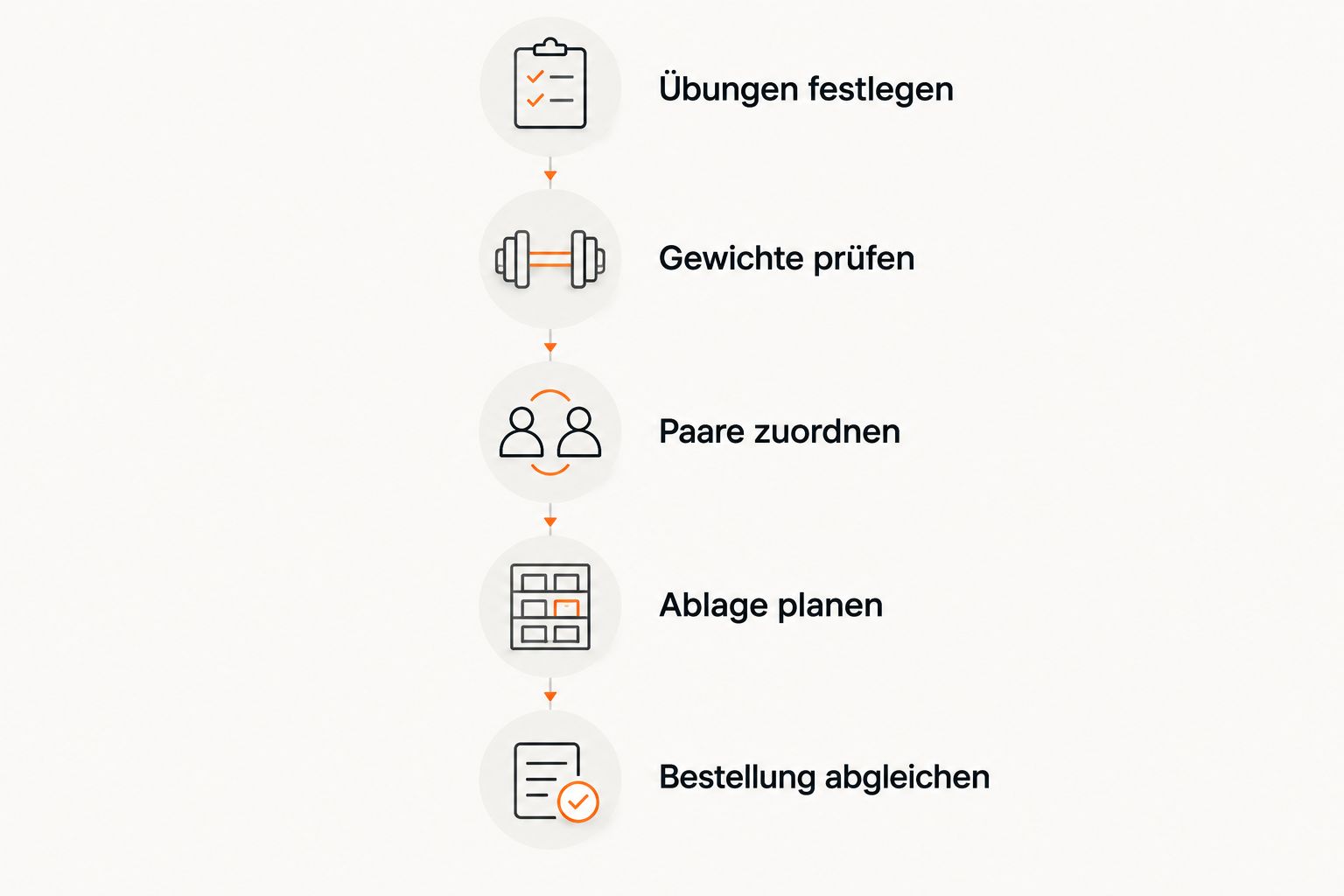
For architects and planners, the coordinated matrix is also helpful. It combines the training concept with the actual occupancy of the storage rack. Do not use generic dimensions, but work with the confirmed dimensions of the selected equipment.
When does an equipment package fit the dumbbell planning?
A package fits if its included weights and components cover your usage concept. Therefore, check it using the same matrix as a individually assembled equipment. The designation as a complete package does not replace this comparison.
The Titanium Strength All-in-One Fitness Studio Package offered by Kraftathlet includes TH20 dumbbells from 2–20 kg and is classified as a home gym package in the product description. This range specification describes the lower and upper value; for your planning, you additionally need the exact weight list and the included quantities. You check the suitability for your commercial business separately using the product documentation.
The advantage of a package is the bundled composition of the mentioned components. The limitation remains its fixed composition: It does not have to match your desired intermediate steps or multiple pairs. Evaluate a package by its content, not by the word "All-in-One".
Kraftathlet is oriented as a partner for studio equipment towards commercial buyers who plan equipment, delivery, assembly, and service together. The concrete specification still remains decisive for the dumbbell selection. Request your configuration with weight list, quantities, and corresponding storage.
Does a small studio need fewer dumbbell increments?
A small studio does not automatically need coarser dumbbell increments. If your training offer requires fine transitions, they remain relevant even on a small area. First limit unnecessary weight ranges and then check the quantities.
Must every weight level be present multiple times?
Not every weight level must be present multiple times. Additional pairs belong where your training concept provides for concurrent demand or the usage shows corresponding overlaps. The decision on multiple pairs remains independent of the decision on intermediate weights.
Is the weight specification of a set sufficient for comparison?
The weight specification of a set is not sufficient for comparison. You need the individual steps, the quantity per step, and the indication whether dumbbells are included individually or in pairs. Only then can you sensibly compare two compositions.
You can find dumbbells in fixed weight levels in the Dumbbells category.
FAQ
What dumbbell increments does my fitness studio need?
Your fitness studio needs weight levels suitable for exercises, users, and concurrent occupancy. Check finer transitions at low working weights and plan multiple pairs separately.
Are equal kilogram steps sensible across the entire dumbbell range?
Equal kilogram steps do not create equal relative weight jumps. From 2 kg to 4 kg, the weight per dumbbell increases by 100%, from 18 kg to 20 kg by around 11.1%.
Should I buy heavier dumbbells or additional pairs first?
Buy according to the problem you need to solve: heavier dumbbells for missing upper working weights, additional pairs for concurrent demand. Too large transitions, on the other hand, you solve with suitable intermediate steps.
How do I compare dumbbell sets for a boutique studio?
Compare the complete weight list, the quantity per weight, and the included storage. A low starting weight and a high end weight alone do not sufficiently describe the composition.
Is a home gym package also suitable for my commercial studio?
A home gym package is not confirmed to be suitable for commercial use solely by its composition. Check the intended use, product documentation, and the conditions for your business separately.
Does the weight of a dumbbell count individually or as a pair?
The reference size must be clearly stated in the respective product description. Two dumbbells weighing 20 kg each weigh 40 kg together; therefore, list the individual weight and the number of pairs separately in your order.
How do I plan the dumbbell rack for later expansion?
Plan the rack based on the intended pairs and their confirmed dimensions. Document additional weight increments and multiple pairs in the expansion plan now, instead of setting up disorganized storage spaces later.
Finally: The missing increment is not always the problem
If a user is regularly waiting for a specific weight, first check the quantity. An additional intermediate increment does not free up the occupied pair. Conversely, a second existing pair does not help if the transition to the next weight is too large for the planned workout.
Therefore, for your 2026 equipment, record two separate questions: “Is a weight missing?” and “Is an available pair missing?” This distinction makes your next order more concrete. For Kraftathlet, it belongs in the same configuration as the dumbbell rack and the rest of the studio equipment.